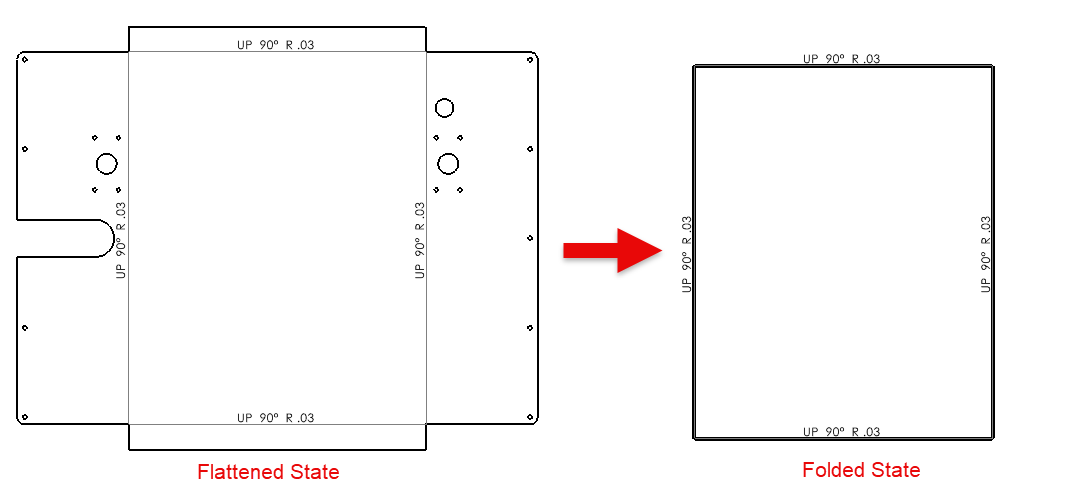
Sometimes, you see your SOLIDWORKS Sheet Metal flat pattern displayed in the folded state. This is usually caused by the Default SM-FLAT-PATTERN derived configuration of the part file being in the folded state. The Default SM-FLAT-PATTERN configuration is a derived configuration of the sheet metal part that is automatically generated the first time the sheet metal part is placed on a drawing.
This derived configuration should always be in the flattened state. If this derived configuration gets folded up, the flat pattern view on the drawing will display in the folded state. Let’s look at why this happens, learn how to correct it, and how to avoid it.
Why is the SOLIDWORKS Sheet Metal Flat Pattern Displayed in the Folded State?
Is this a bug that causes the SOLIDWORKS Sheet Metal Flat Pattern to get folded up? The answer to that question is “No”. This is not caused by a bug in the software and is typically caused by a lack of understanding of how sheet metal flat patterns work in SOLIDWORKS. It typically happens when the user opens the part file by right-mouse clicking on the flat pattern view on the drawing and selects “Open Part”.
 Opening a part from the flat pattern in a SOLIDWORKS drawing
This opens the part file with the Default SM-FLAT-PATTERN configuration active. The user, not realizing they are on the Default SM-FLAT-PATTERN configuration, folds the part up to continue work. Since this is the configuration that the flat pattern view on the drawing references, when they return to the drawing, the flat pattern view shows in the folded state.

The default Flat Pattern configuration activated and flattened
How Do We Fix It?
This is easily corrected. Just open the part file, switch to the Default SM-FLAT-PATTERN derived configuration, click the Flatten icon to put it in the flattened state, and save the file. The flattened view on the drawing should automatically flatten the next time it is opened.
How Do We Prevent This in The Future?
This is easily prevented by paying attention to which configuration is active. If the user opens the part from one of the folded views on the drawing, it will open to the main configuration. If they open it by right-mouse clicking on the flat pattern view, they will need to make sure to switch to the Default configuration of the part before proceeding.
Considerations When Working in a SOLIDWORKS PDM Environment
This behavior may manifest itself slightly differently in a SOLIDWORKS PDM environment. In a PDM environment, it’s not uncommon for one user to create the sheet metal part file and check it into the vault. Later, another user comes along and creates the 2D drawing of the sheet metal part. Now, consider what was mentioned earlier, the Default SM-FLAT-PATTERN derived configuration is automatically added to the part file the first time a flat pattern view is added to a drawing. If that part file is checked into the vault, the user will not have write access to the file.

Sheet Metal Model in the Flattened and Folded States
When they add the flat pattern view to the drawing, it will create the Default SM-FLAT-PATTERN derived configuration in the part and allow the user to add the flat pattern view to the drawing and dimension it. However, when they close the file, the changes to the part file will get discarded because the file is checked into the vault and read-only. The next time the drawing is opened, the user will get a notification that the Default SM-FLAT-PATTERN configuration can’t be found, and it will switch the view reference to use an existing configuration, which is usually in the folded state.
Fixing the Flat Pattern in SOLIDWORKS PDM
If you see the SOLIDWORKS Sheet Metal flat pattern displayed in the folded state, the result is similar, but the solution is different. In this case, the user will need to close the drawing without saving any changes, check the part file out, create a temporary drawing, add the flat pattern view to the temporary drawing to trigger the creation of the Default SM-FLAT-PATTERN configuration, then save the part file and check it back into the vault. The temporary drawing can be closed without saving. The next time the drawing from the vault is opened, it should find the Default SM-FLAT-PATTERN configuration and open properly.
To learn other time-saving SOLIDWORKS Sheet Metal workflows, register for an upcoming training course here.
Cloud Software
law
4
Berita Olahraga
Lowongan Kerja
Berita Terkini
Berita Terbaru
Berita Teknologi
Seputar Teknologi
Berita Politik
Resep Masakan
Pendidikan


