As data security becomes a greater priority across industries, understanding how your tools handle encryption is more important than ever. As a system administrator, handling SOLIDWORKS PDM data encryption and ensuring it aligns with your IT policies, compliance standards, and protecting your intellectual property is imperative to success.
Fortunately, SOLIDWORKS PDM has made great strides in recent years to increase data encryption and provide more options to tailor it to your needs. Here’s a breakdown of what encryption looks like in the world of SOLIDWORKS PDM.
What Is Encryption?
At its core, encryption is the process of protecting information by converting it into a coded format using mathematical algorithms. Only the parties with the right decryption key can make the information readable again. This shields data from unauthorized access during storage or transmission.
There are two main types of encryption: symmetric and asymmetric. These types are defined by who is encrypting and decrypting data and how they are doing it.
Symmetric uses a single key for encryption and decryption, whereas asymmetric uses multiple keys to encrypt data on one end and decrypt data on the other. One notable example is Public Key cryptography, where the public is given an encryption key, but the decryption key is kept private to secure data.
 An example of symmetric encryption
Encryption can also be applied to data in transit, meaning that data is moving between systems, while data is at rest, referring to data that is stored in a disk or database. The most secure path for keeping data safe during all of these operations is end-to-end encryption (E2EE). This means that data is encrypted from the moment it leaves the sender until it reaches the receiver. No middle point, such as a server or router, can access the unencrypted information. Most major messaging apps like WhatsApp and iMessage use this technology.
What is Encrypted in PDM?
Encryption between the PDM client and archive server has evolved over time. Earlier software releases transmitted data between these sources over unencrypted TCP sockets. SOLIDWORKS 2023 was the first release that saw SOLIDWORKS PDM encrypting data between the archive server and client, and in 2025, they changed from the MD5 hash algorithm to the AES-128 algorithm, which is Federal Information Processing Standards (FIPS) Compliant.
By default, SQL communication in PDM is not encrypted, but it can be secured using:
- SSL (Secure Sockets Layer)
- TLS (Transport Layer Security)

Insecure SOLIDWORKS PDM data encryption without SSL
To do this, you must configure SQL Server to use a certificate. This ensures encrypted communication between your SQL Server and PDM clients. Microsoft has instructions for how to do this on their website if you’d like a step-by-step guide. PDM web traffic is also unencrypted by default, but you can configure it to use HTTPS (SSL) for secure access.
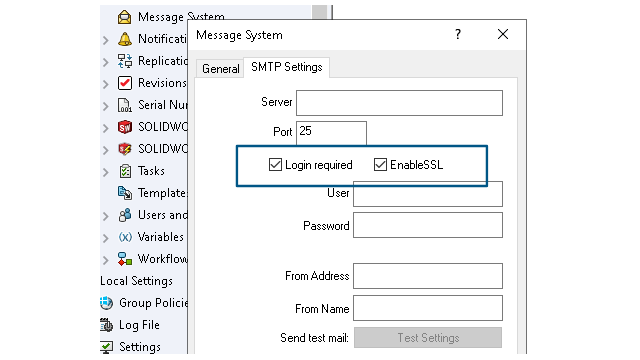
SOLIDWORKS PDM data encryption configuration for email notifications
Common SOLIDWORKS PDM Encryption-Related Questions
Here are some useful knowledge base articles that provide clarity around encryption and SOLIDWORKS PDM:
- QA00000411348 – Is PDM FIPS Compliant?
PDM 2025 and later uses AES-128, which is FIPS 140-2 compliant. Older versions using MD5 are not. - QA00000120807 – Can I Use Bitlocker with PDM?
Bitlocker is not officially supported. SOLIDWORKS QA does not test Bitlocker configurations. - QA00000105257 – Does PDM Support Microsoft EFS?
No, SOLIDWORKS PDM does not support the Encrypting File System (EFS) for securing file traffic. - QA00000106295 – Can I Encrypt SQL Data in PDM?
Yes, but it requires manual configuration in SQL Server using certificates and SSL/TLS.
Data encryption in SOLIDWORKS PDM continues to improve with each release, and SOLIDWORKS 2025 marks a significant step forward with the adoption of AES-128 encryption. Still, it’s important for administrators to understand how and what data is encrypted in order to implement best practices for securing traffic between server components and clients. If your organization handles sensitive or regulated data, keeping your PDM system updated and configuring encryption properly is something that our professional services team can assist you in doing.
To learn more about SOLIDWORKS PDM data encryption, watch our on-demand webinar here.