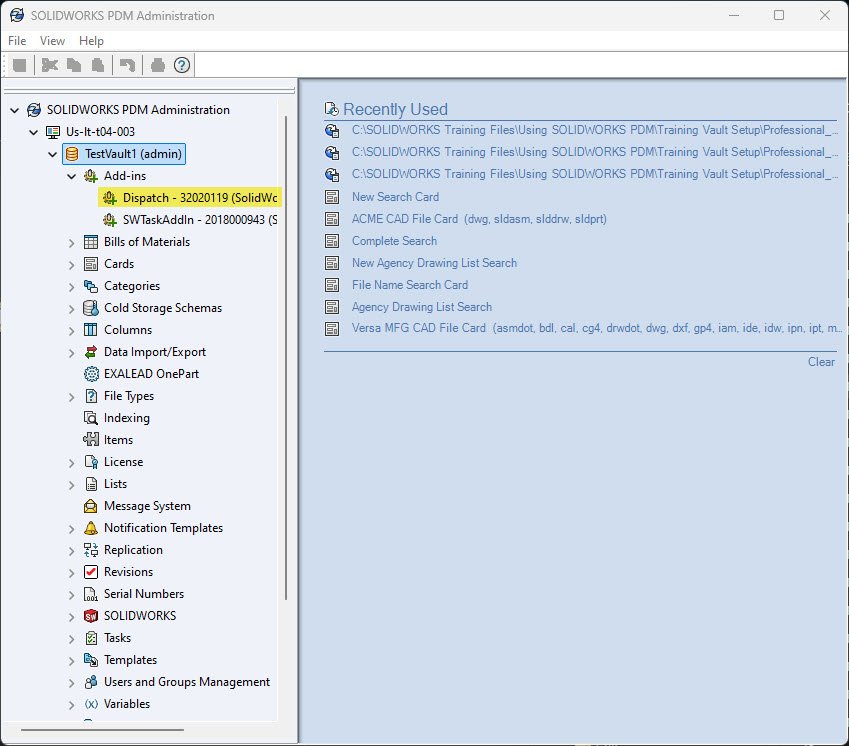
SOLIDWORKS PDM Dispatch is a small programming tool that comes standard with SOLIDWORKS PDM Professional. Commonly referred to as Dispatch, this program allows you to automate tasks and is fully customizable to meet your needs.
If the dispatch add-in is installed in a SOLIDWORKS PDM Professional vault, it can trigger a variety of events. In the example below, we will create a dispatch action to rename a file in the PDM vault using the menu option.
Automatically Renaming Files in SOLIDWORKS PDM
A commonly automated task is to rename a large number of vaulted files based on a user input or with data card variables. Doing this by hand would require a lot of manual effort, and custom-coding an external tool would require many man-hours.
SOLIDWORKS PDM Dispatch is the perfect solution for traditionally tedious tasks.
Opening Dispatch in the SOLIDWORKS PDM Administration Tool
Dispatch rules are created in the SOLIDWORKS PDM Administration tool and are typically reserved for admins.
To open Dispatch:
- Log in to the SOLIDWORKS PDM Administration tool with elevated credentials.
- Expand the Add-ins section.
- Double-click on Dispatch.
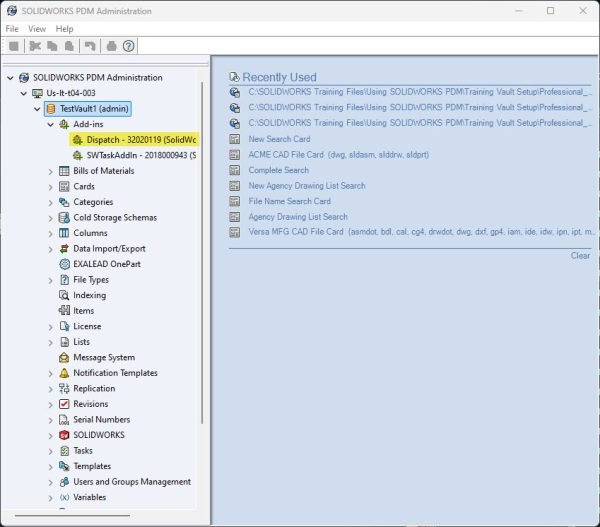 SOLIDWORKS PDM Administration Tool
 - In the bottom left of the window, select Administrate Actions to launch the rules window.
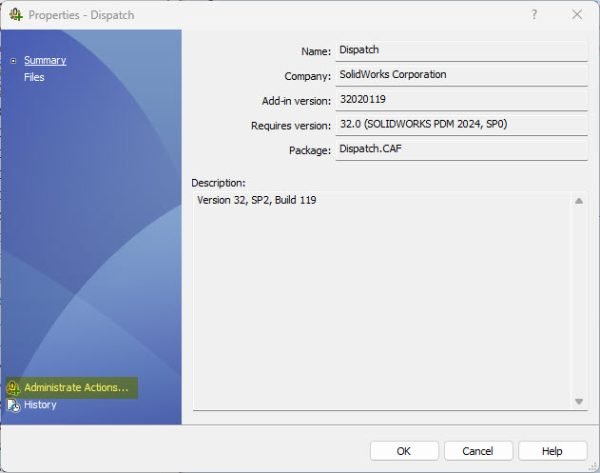 Administrate Actions
Creating a New Dispatch Rule
The logic of Dispatch comes from the rules that are created and will serve as instructions to tell your vault how to automate.

Adding a new Dispatch action
To create a new SOLIDWORKS PDM Dispatch action:
- Click Add… to start creating a new rule.
- Enter a descriptive name for the rule.
 Setting up an action to rename SOLIDWORKS files
 - Select an activation method.
- Menu command will give the rule a menu option in the right-click menu. This option can be beneficial for batch-updating legacy files without using a transition to change their states.
- During state transition will let you define conditions for when the rule activates during a workflow change. Additional arguments can be added for file paths and workflow states.
- During check out will let you define conditions for when the rule activates when checking in files. Additional arguments can be added for file path and if the rule triggers before or after check out.
- During add will run the rule when a new file is added to the vault.
- Click OK to confirm.
For our guide, use the Menu command before proceeding.
Creating Variables for the Action
Once the name, description, and activation method are determined, you have to create variables to tell the Dispatch rule what to update. These can be static strings, variable strings, system variables, or a combination.
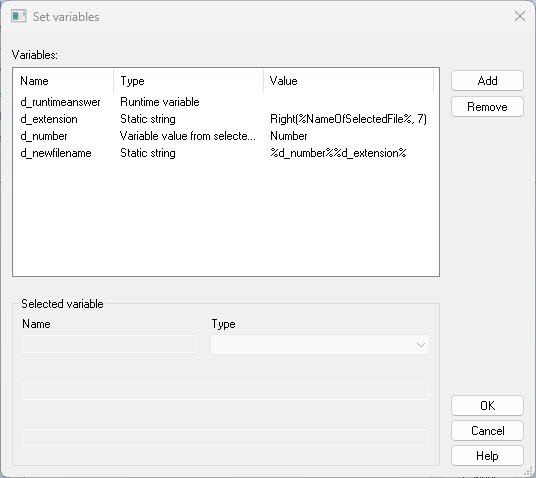
Required variables for renaming SOLIDWORKS files
For a Dispatch rule that renames SOLIDWORKS files, you need the following variables:
- A runtime variable
- A variable to capture the extension of the selected file or files
- A variable to capture the existing file name
- A variable to store the next file name
Creating the Dispatch Logic
After the variables are set, move on to defining the logic for the Dispatch rule. As you are working through the logic and need more variables, you can always go back to add more.
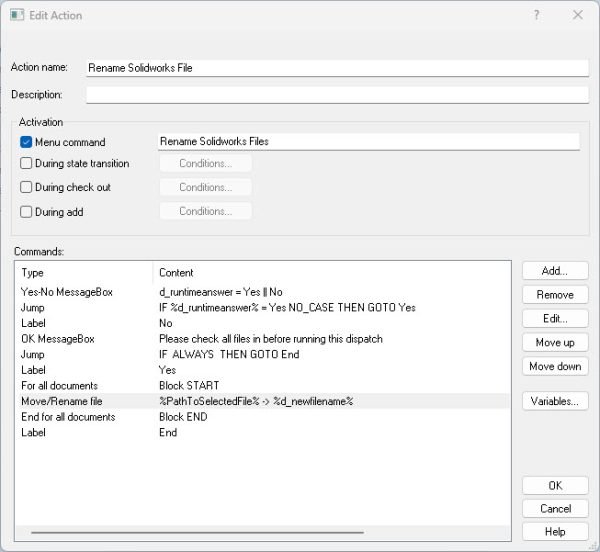
Finalized Dispatch logic to rename files
Warning Message Box
Create a Yes-No MessageBox step using the runtime variable to give a final confirmation step before running the script.
If Statement
Create a Jump step with an IF statement that checks whether the previous step is true or false.
- If No: The Dispatch script will jump to the end of the script without running logic.
- If Yes: The Dispatch script will proceed with the automation.
Renaming Files
Create a Move/Rename file step that will take the original file path and rename it based on the variables. This step should only trigger if the IF statement proceeds.
End Block
At the end of the logic block, create an END step. This will exit out of the logic and stop it from consuming resources.
Enhanced Automation with Custom Dispatch Programming
For simple SOLIDWORKS PDM automation, creating a custom Dispatch script yourself is a great way to streamline engineering. However, as automations get more complex and the affected file list grows, it can introduce more room for errors with production if not set up correctly.
It is important to be confident in the generated scripts, and someone who might not do this often may do more harm than good. That’s where our team of experts comes in to help you build, test, and deploy automation to keep engineering moving forward.
Click here to learn more about our SOLIDWORKS PDM services that help both small businesses and large enterprises.
PakarPBN
A Private Blog Network (PBN) is a collection of websites that are controlled by a single individual or organization and used primarily to build backlinks to a “money site” in order to influence its ranking in search engines such as Google. The core idea behind a PBN is based on the importance of backlinks in Google’s ranking algorithm. Since Google views backlinks as signals of authority and trust, some website owners attempt to artificially create these signals through a controlled network of sites.
In a typical PBN setup, the owner acquires expired or aged domains that already have existing authority, backlinks, and history. These domains are rebuilt with new content and hosted separately, often using different IP addresses, hosting providers, themes, and ownership details to make them appear unrelated. Within the content published on these sites, links are strategically placed that point to the main website the owner wants to rank higher. By doing this, the owner attempts to pass link equity (also known as “link juice”) from the PBN sites to the target website.
The purpose of a PBN is to give the impression that the target website is naturally earning links from multiple independent sources. If done effectively, this can temporarily improve keyword rankings, increase organic visibility, and drive more traffic from search results.


