A SOLIDWORKS network allows distributed teams to share a pool of licenses and only take ownership when they use the software. This works great with everyone on the same network or connecting through a VPN, but for those without an internet connection, there needs to be another method to pull a license.
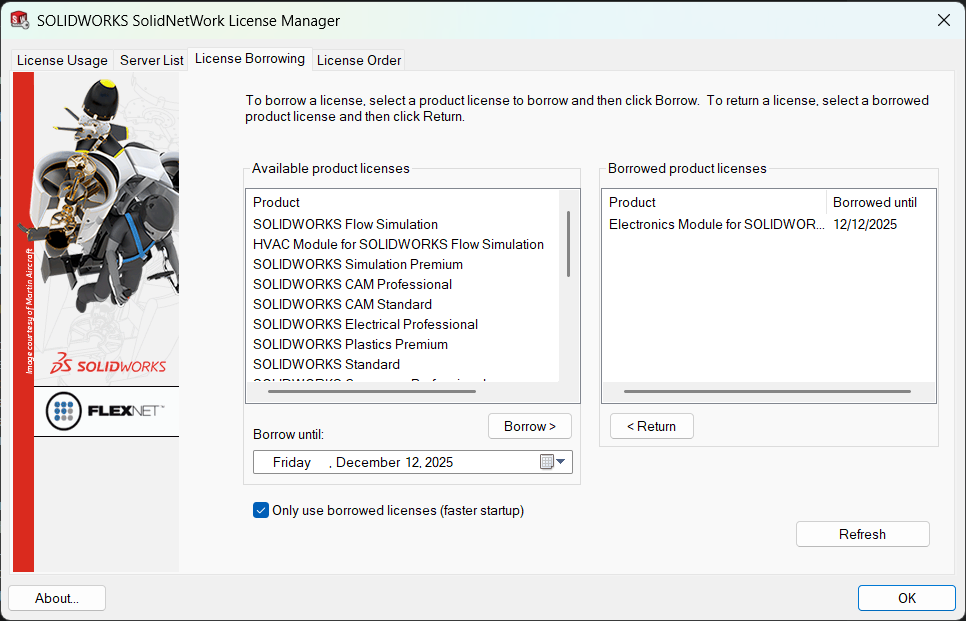
Borrowed licenses let a user reserve a software entitlement, disconnect from the network, and continue to work offline. SOLIDWORKS 2025 added the ability to only use borrowed licenses, resulting in a variety of benefits.
Why Should You Only Use Borrowed Licenses?
By only using borrowed licenses, SOLIDWORKS’ startup will be faster since it does not need to ping the license server to check activation status. This is a quick user-controlled alternative to an options file that can be applied at the server level.
The SolidNetWork License Manager with the option to restrict borrowed licenses
Additionally, this can be used to prevent a user from unintentionally pulling a higher-level package. For example, someone may accidentally turn on the SOLIDWORKS Routing add-in and pull a SOLIDWORKS Premium license when they really only needed Standard.
What Are the Limitations of Borrowing Licenses?
Time Limit
Licenses can be borrowed for up to 30 days and then are returned automatically at the end of the time frame, or can be returned manually via the License Borrowing tab of the SolidNetWork License Manager. While borrowed, the user can work offline and away from the network to better support off-site work.
Failing to Obtain a License
If a user borrows a license and returns to the office before the end of the borrowing period, SOLIDWORKS will continue to work since the license is still borrowed. However, if they try to launch another SOLIDWORKS tool, they would potentially receive the “Failed to obtain a license” error.

This is because the SolidNetWork License Manager Client is set to only use borrowed licenses even when connected to the local SOLIDWORKS network. To solve this, either disable the setting or return the borrowed licenses.
How to Only Use Borrowed SOLIDWORKS Licenses
Without any borrowed licenses, the option to solely use them is grayed out.
To only use borrowed licenses:
- Open the SolidNetWork License Manager.
- Switch to the License Borrowing tab.
- Borrow the licenses you want to use.
- Select the option to Only use borrowed licenses.
When selecting SOLIDWORKS Premium or Professional licenses, you will receive a pop-up to borrow either the Professional/Premium or a SOLIDWORKS Standard license. Selecting the Premium/Professional option will also bring Standard to the borrowed section as they are both required.

Choosing between SOLIDWORKS Standard and Premium when borrowing licenses
You will need to select any products that you plan to use when disconnected from the network. It is important to do so before leaving because it is not recommended to borrow a license over a VPN connection after the fact.
Additional Tools to Enable Remote Work
SOLIDWORKS has a variety of tools that enable collaboration from both local and remote employees. Borrowing a license is just the beginning of enabling remote work for your team.
Many engineering design teams need to collaborate across remote or hybrid environments. SOLIDWORKS PDM can be a vital tool for staying connected to design data when paired with the right architecture and access methods.
To learn more about working remotely with SOLIDWORKS PDM, read our guide here.
PakarPBN
A Private Blog Network (PBN) is a collection of websites that are controlled by a single individual or organization and used primarily to build backlinks to a “money site” in order to influence its ranking in search engines such as Google. The core idea behind a PBN is based on the importance of backlinks in Google’s ranking algorithm. Since Google views backlinks as signals of authority and trust, some website owners attempt to artificially create these signals through a controlled network of sites.
In a typical PBN setup, the owner acquires expired or aged domains that already have existing authority, backlinks, and history. These domains are rebuilt with new content and hosted separately, often using different IP addresses, hosting providers, themes, and ownership details to make them appear unrelated. Within the content published on these sites, links are strategically placed that point to the main website the owner wants to rank higher. By doing this, the owner attempts to pass link equity (also known as “link juice”) from the PBN sites to the target website.
The purpose of a PBN is to give the impression that the target website is naturally earning links from multiple independent sources. If done effectively, this can temporarily improve keyword rankings, increase organic visibility, and drive more traffic from search results.

