SolidCAM Turning is, quite simply, one of the best CAM solutions available for the CNC Programming market. It allows your CNC Programmer to apply an advanced suite of turning technologies to any design with ease.
Today’s machine tools are leaps and bounds more advanced than they were even a generation ago. With much more capable two-axis turning centres, the rise of Swiss-type machines, mill-turn machines, and universal machining centers has blurred the lines between what is milling and what is turning.
1. Core Turning Capabilities
SolidCAM turning offers complete support for turning operations that can apply to any geometry, no matter how simple or complex.
- Facing and OD/ID operations allow for precise control over the final part output.
- Grooving and part-off include basic canned cycles along with specialized cutting strategies to increase tool life.
- Drilling, boring, reaming, and tapping operations can be easily customized and integrated into existing programs.
2. Advanced Turning Capabilities
Along with the traditional turning strategies and operations, SolidCAM includes support for advanced turning strategies. These additional features can help optimize your toolpaths and ensure your toolpaths are more efficient.
- Trochoidal Turning: A toolpath that uses rounded passes to optimize tool engagement for maximum material removal, while extending tool life.
 Trochoidal toolpaths on a turned part
 - Balanced Rouching: to allow the use of two turning tools in multiple turret machines and allow for both Balanced and Pinch-Turning operations.
- Simultaneous Tilted Turning: On machines with a B-axis, the turret will turn while cutting, allowing complex geometries to be machined with a single tool.
3. SOLIDWORKS Integration
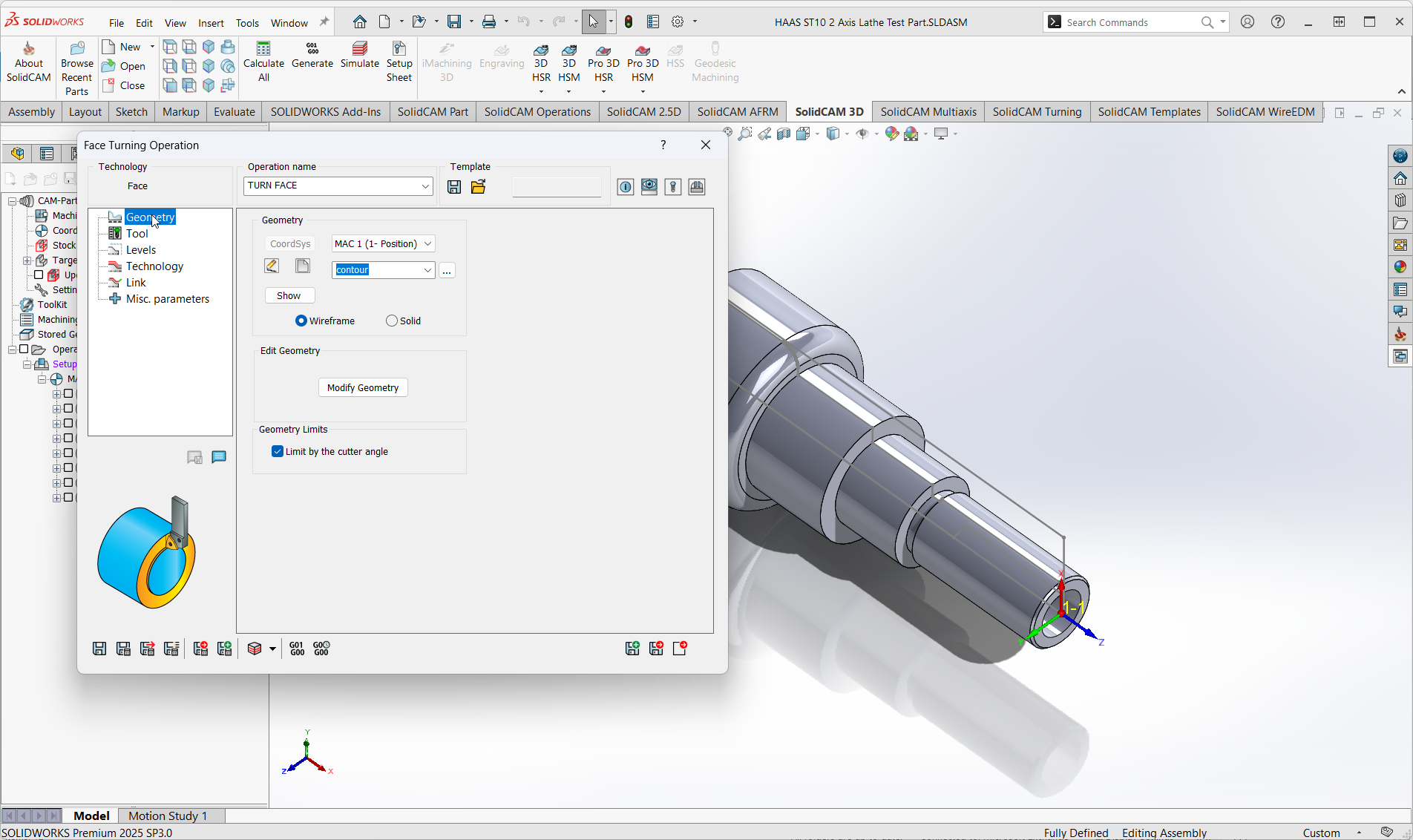
Unlike many stand-alone CAM solutions, SolidCAM is integrated directly into the SOLIDWORKS environment. This means that you can maintain direct association with your engineering designs.

SolidCAM programming inside SOLIDWORKS
Any changes made to your models can be automatically reflected in your programmed geometry, creating a unified workflow. Engineers and machinists can work together in the same environment, which in turn allows your engineering and manufacturing teams to collaborate more directly with each other.
If you have engineers comfortable with SOLIDWORKS, then jumping into SolidCAM will not be a steep learning curve.
4. Unified Programming Environment
SolidCAM seamlessly integrates into all the machines on your shop floor, including mill-turn, multitasking, and Swiss machines, using the same easy-to-navigate programming environment. There is no need to run separate CAM modules as the machine kinematics are controlled by the postprocessor.
Ultimately, controlling the B and Y axes on multi-turret or multi-spindle machines is fully optimized with SolidCAM. You can take full advantage of machine kinematics and synchronization without the costly overhead of traditional CAM solutions.
5. Toolpath Optimization
SolidCAM’s toolpaths are built to calculate the most efficient toolpath for your geometry. Collision detection and avoidance help check for potential collisions between your tools and workpiece, as well as between your machine and tools.

SolidCAM iMachining toolpaths
The patented iMachining technology helps redefine expected roughing toolpaths by optimizing cutting conditions in real time. SolidCAM guarantees better machine performance by reducing cycle time and increasing tool life.
6. Machine Simulation
Mistakes in programming can be very costly, so it is important to verify your toolpaths before sending code to a machine. It is much better to crash tools during a simulation than when cutting material.
SolidCAM provides four different simulation modes to help verify your programs.
- Host CAD Simulation: Visualize your turning operations directly within your CAD environment, seeing exactly how the tool interacts with your model.
 Turning simulation running in SOLIDWORKS
 - Turning Simulation: Step through each operation in detail, checking for errors, collisions, and inefficiencies.
- SolidVerify: A high-fidelity, material-removal simulation that shows the actual result of your toolpaths, allowing you to catch issues before they reach the shop floor.
 Material removal simulation
 - Machine Simulation: SolidCAM’s optional machine simulation allows for seeing the tool, part, and machine run in a full 3D simulation to check for things like turret interferences, tools sticking out, and even a tool interfering with the machine housing.
Implementing SolidCAM Turning for Your Business
By implementing SolidCAM for turning, you can reduce machining time and increase tool life. This not only speeds up production but also allows for more jobs to be completed in the same timeframe, making your shop more cost-effective and competitive.
No longer do you have to maintain complex programs or generate code at the machine. With SolidCAM, you can generate accurate programs, machine smarter, and manufacture faster.
To see how SolidCAM compares to other CAM platforms, read our guide here.
PakarPBN
A Private Blog Network (PBN) is a collection of websites that are controlled by a single individual or organization and used primarily to build backlinks to a “money site” in order to influence its ranking in search engines such as Google. The core idea behind a PBN is based on the importance of backlinks in Google’s ranking algorithm. Since Google views backlinks as signals of authority and trust, some website owners attempt to artificially create these signals through a controlled network of sites.
In a typical PBN setup, the owner acquires expired or aged domains that already have existing authority, backlinks, and history. These domains are rebuilt with new content and hosted separately, often using different IP addresses, hosting providers, themes, and ownership details to make them appear unrelated. Within the content published on these sites, links are strategically placed that point to the main website the owner wants to rank higher. By doing this, the owner attempts to pass link equity (also known as “link juice”) from the PBN sites to the target website.
The purpose of a PBN is to give the impression that the target website is naturally earning links from multiple independent sources. If done effectively, this can temporarily improve keyword rankings, increase organic visibility, and drive more traffic from search results.


