The Peltier effect is a phenomenon observed in thermoelectric coolers when an electric current is maintained in a circuit of two dissimilar conductors. This results in the cooling of one junction and heating of the other.
SOLIDWORKS Flow Simulation has a built-in feature that allows you to define and model thermoelectric coolers to obtain accurate results from your flow studies.
What is a Thermoelectric Cooler?
A thermoelectric cooler uses the Peltier effect to create a heat flux between the junction of two different types of materials. Thermoelectric cooling is also known as solid-state cooling, because there is no liquid refrigerant running through the machine. Instead, solid metal is used to transfer thermal energy.
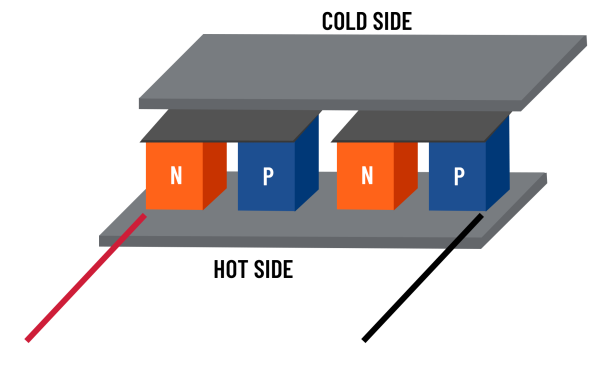 The anatomy of a thermoelectric cooler
With advancements in semiconductor materials, thermoelectric assemblies are used in electronics, consumer products, and military applications. Thermoelectric coolers have an advantage over traditional vapor compression technology because of their compact construction, quiet operation, and lack of moving parts.
Modeling Thermoelectric Coolers with SOLIDWORKS
When it comes to thermal management of products containing thermoelectric coolers, SOLIDWORKS Flow Simulation gives you the right levers to virtually model them. In accordance with the Peltier effect, when a direct electric current (DC) is run through a circuit, the heat is pumped from the cold side to the hot side.
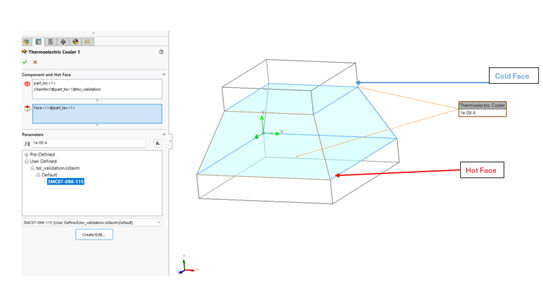
Defining a thermoelectric cooler in SOLIDWORKS Flow Simulation
The cold and hot sides are determined from the DC direction. This heat pumping is accompanied by the Joule (ohmic) heat release at both surfaces and the heat transfer from the hotter side to the colder. In addition to the heat generated by the heat source, adding a thermoelectric cooler can further add to the heat instead of cooling if not defined correctly.
How to Define a Thermoelectric Cooler in SOLIDWORKS Flow Simulation
The basic steps to define a thermoelectric cooler in SOLIDWORKS Flow Simulation are:
- Select a flat plate (box) in the SOLIDWORKS model.
- Assign its hot face. The hot face specified for the cooler must be in contact with other solids and not fluids.
- Apply one of the thermoelectric coolers already defined in the Engineering Database or custom define as needed.

Using the Engineering Database to define cooling parameters
This will apply the cooler to your existing CFD study and allow you to simulate the cooler effect. If you flip your hot and cold faces, the results will not be accurate, so be careful with your selections.
Other Considerations for Your Flow Study
Hot Face Definition
The hot face is defined as in contact with another solid component, such as a heat sink, while the cold face is in contact with a cooled heat source. SOLIDWORKS Flow Simulation automatically assigns specific functional boundary conditions to the cold and hot surfaces for the thermoelectric cooler.
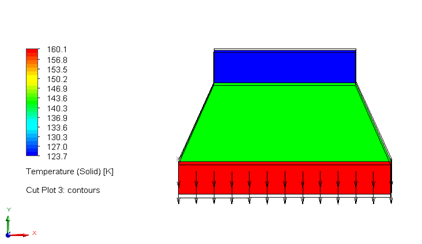
Results from a study using a thermoelectric cooler
Therefore, these surfaces must not have any other boundary conditions assigned to them. For example, if contact resistance needs to be assigned, it must be defined for solid bodies that are not part of the definition.
Thermoelectric Cooler Specifications
To create a custom thermoelectric cooler in the Engineering Database, you need to provide the following information:
- The maximum DC current, Imax (always positive), for two hot-side surface temperature (Th) values.
- The maximum heat Qcmax transferred at this Imax at ΔT = 0 for two Th values
- The maximum temperature difference ΔTmax, attained at Qc = 0 for two Th values
- The voltage Vmax corresponding to Imax for Th values (Th is the hot-side surface temperature)
Thermoelectric cooler suppliers will provide the above information, and SOLIDWORKS Flow Simulation will use the information to calculate the remaining values needed. The efficiency of the cooler can be improved by either increasing the temperature of the hot surface or decreasing the value of the current.
Utilizing Advanced Setup Tools in SOLIDWORKS Flow Simulation
The thermoelectric cooler modeling feature in SOLIDWORKS Flow Simulation can help you improve your thermal product designs to achieve the required cooling and heating requirements. This is just scratching the surface of what is possible with SOLIDWORKS Flow Simulation.
To learn more about what is possible with SOLIDWORKS Flow Simulation, reach out to us today.
News
Berita Teknologi
Berita Olahraga
Sports news
sports
Motivation
football prediction
technology
Berita Technologi
Berita Terkini
Tempat Wisata
News Flash
Football
Gaming
Game News
Gamers
Jasa Artikel
Jasa Backlink
Agen234
Agen234
Agen234
Resep
Cek Ongkir Cargo
Download Film