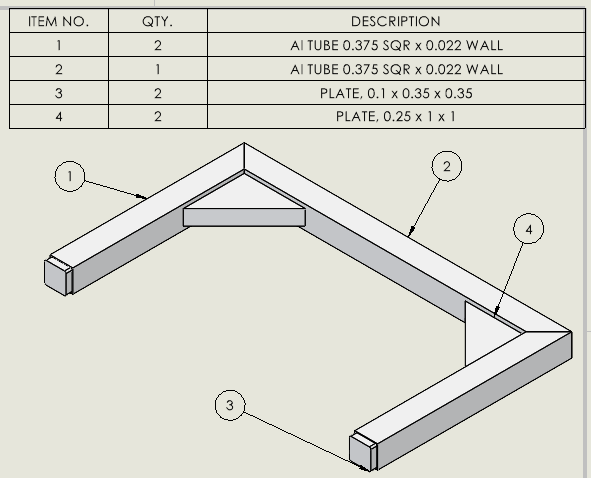
SOLIDWORKS Weldments includes tools to create end caps and gussets so you can more accurately define your welded structures. With these tools, you can add stability and security to your model, increasing its longevity.
End caps are added to the ends of your profiles, such as square or circular tubing, where gussets are applied between two members to increase support. Regardless of which tool you use, they are included in the weldment cut list, but often don’t come with a description.
 End caps and gussets missing descriptions in a cut list
If you have either of these two in your SOLIDWORKS weldments model, you may have noticed that a description is not populated when creating a weldment cut list in a SOLIDWORKS drawing. Fortunately, adding the descriptions is a simple process, so you’ll have a fully detailed cut list in no time.
Adding Descriptions for End Caps and Gussets
Adding a description to the weldments cut list for the items is a simple process that takes only a few steps. It requires creating a bounding box through each Cut-List-Item folder individually in the part file, which will allow the weldments cut list to update with descriptions in the drawing.
1. Create Bounding Boxes
To create a bounding box, open your weldment in SOLIDWORKS and right-click on the Cut-List-Item folder for your end caps or gussets. Then, choose the option Create a Bounding Box to automatically create a box that encapsulates the cut list item.

Creating cut list bounding boxes
2. Update the Drawing
Open the associated drawing in SOLIDWORKS to allow the cut list to update with descriptions. If the cut list does not update with descriptions automatically, test completing a rebuild for the drawing using Ctrl + Q.

An updated cut list with description
The description is determined by combining the length, width, and thickness calculated from the bounding box. This is automatically generated once the bounding box is created, along with a handful of other properties.
Other Cut List Properties
When creating a bounding box, various properties are automatically generated for the items. This allows the descriptions to populate in the weldments cut list in the drawing.
To view the other generated cut list properties:
- Open a SOLIDWORKS file with weldments.
- Right-click on Cut-List-Item folder.

- Select Properties.
- Review the automatically generated cut list properties.

Cut list properties for end caps and gussets
In the cut list properties, we can see how creating a bounding box generates the following properties:
- 3D-Bounding Box Thickness
- 3D-Bounding Box Width
- 3D-Bounding Box Length
- 3D-Bounding Box Volume
Accurate Drawing Tables
Adding descriptions for end caps and gussets gets you closer to 100% accurate SOLIDWORKS drawings, improving your engineering and manufacturing workflows. By customizing your weldment cut lists, you remove ambiguity from drawings and make it easier to pass knowledge down as information flows downstream.
To learn more tools to improve your weldment models, register for a training course here.
PakarPBN
A Private Blog Network (PBN) is a collection of websites that are controlled by a single individual or organization and used primarily to build backlinks to a “money site” in order to influence its ranking in search engines such as Google. The core idea behind a PBN is based on the importance of backlinks in Google’s ranking algorithm. Since Google views backlinks as signals of authority and trust, some website owners attempt to artificially create these signals through a controlled network of sites.
In a typical PBN setup, the owner acquires expired or aged domains that already have existing authority, backlinks, and history. These domains are rebuilt with new content and hosted separately, often using different IP addresses, hosting providers, themes, and ownership details to make them appear unrelated. Within the content published on these sites, links are strategically placed that point to the main website the owner wants to rank higher. By doing this, the owner attempts to pass link equity (also known as “link juice”) from the PBN sites to the target website.
The purpose of a PBN is to give the impression that the target website is naturally earning links from multiple independent sources. If done effectively, this can temporarily improve keyword rankings, increase organic visibility, and drive more traffic from search results.


