SOLIDWORKS PDM is the proper tool for handling all the complex file references with your CAD data, so you can focus on designing. By using SOLIDWORKS PDM, you can avoid costly broken references and the time spent trying to fix them.
This functionality is extended further by the SOLIDWORKS PDM add-in that provides direct integration to SOLIDWORKS Design and introduces a single interface for modeling and data management.
How to Turn on the SOLIDWORKS PDM Add-in
To enable the SOLIDWORKS PDM add-in, you first need to ensure it is installed on your machine. If it is not installed, contact your administrator to provide a license and proceed with installation.
 Enabling the SOLIDWORKS PDM add-in for SOLIDWORKS
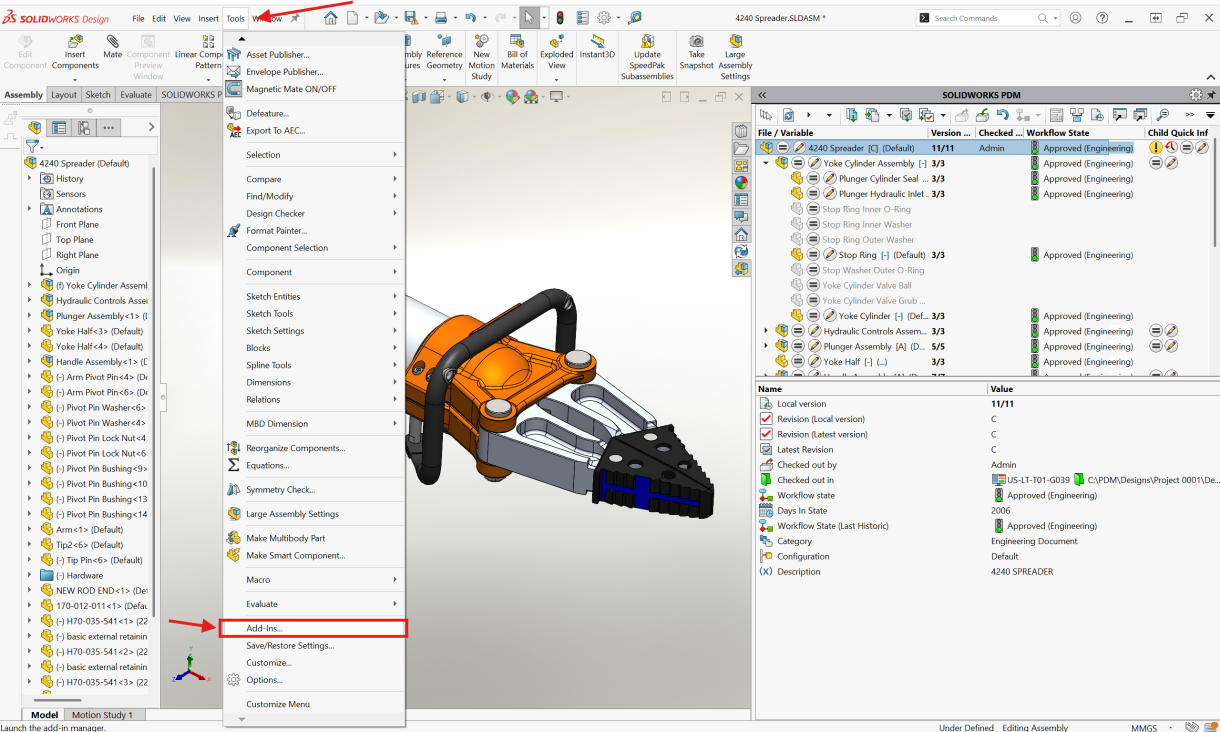
Like any other SOLIDWORKS add-in, it is enabled through the Add-in menu. This can be done with two different workflows, depending on your preference.
- Open the Tools menu and select Add-Ins before enabling SOLIDWORKS PDM.
- Use the dropdown next to the Settings icon and select Add-Ins before enabling SOLIDWORKS PDM.
What is the SOLIDWORKS PDM Add-in Used For?
Once the add-in is installed and activated, a new icon will appear in the SOLIDWORKS Task Pane that is the SOLIDWORKS PDM Blueberry. This section of the Task Pane is separated into three different sections, each with its own purpose.
The Action Bar
SOLIDWORKS PDM users have actions that they are constantly doing: checking files in or out, getting the latest version of a file, or changing the state for approvals. The action bar gives quick access to the most commonly completed SOLIDWORKS PDM tasks.

The SOLIDWORKS PDM Task Pane menu
SOLIDWORKS PDM data cards can also be accessed from this section of the add-in. If you need to make edits to the data cards, you don’t have to open Windows File Explorer to change them. Information is readily available directly inside SOLIDWORKS.
Finally, the search tool is integrated with SOLIDWORKS, allowing you to use your customized search cards to find files in the vault easily. The searches available correlate to the logged-in user’s permission, so you have quick access to everything you normally would.
CAD File Information
The middle section of the add-in provides information about the CAD file currently open in SOLIDWORKS. Some of the information available includes the current state of the file, the type of file, version information, and revision.
Some of the parts may even be highlighted red if they are an older version, so you always know right away what version you are working with. Other graphical information is displayed with various icons to give you quick access to data.

SOLIDWORKS PDM file status icons
Right-clicking on a file in this section will open a sub-menu with additional SOLIDWORKS PDM tools that are displayed in the action bar. If you need to open a part file from an assembly, just right-click on the associated file and open it directly from the dropdown.
File Version Information
The final section is at the bottom of the Task Pane. Some of this information is duplicated in other areas, but it provides a quick reference for useful information.
Key pieces of information in this section include the days a file is in the current state, what category they are sorted in, and which workflow a file is currently in.
The SOLIDWORKS PDM CommandManager Tab
For SOLIDWORKS PDM 2025 and newer, there is a new tab added to the SOLIDWORKS CommandManager. This new tab adds much of the SOLIDWORKS PDM functionality that was traditionally present in the Task Pane to the CommandManager.

The new CommandManager tab for data management
The tab can be turned on by customizing the CommandManager. This way, SOLIDWORKS PDM tools are treated like any other tool in the SOLIDWORKS toolset.
To learn more about new features added to SOLIDWORKS PDM, watch our video here.
PakarPBN
A Private Blog Network (PBN) is a collection of websites that are controlled by a single individual or organization and used primarily to build backlinks to a “money site” in order to influence its ranking in search engines such as Google. The core idea behind a PBN is based on the importance of backlinks in Google’s ranking algorithm. Since Google views backlinks as signals of authority and trust, some website owners attempt to artificially create these signals through a controlled network of sites.
In a typical PBN setup, the owner acquires expired or aged domains that already have existing authority, backlinks, and history. These domains are rebuilt with new content and hosted separately, often using different IP addresses, hosting providers, themes, and ownership details to make them appear unrelated. Within the content published on these sites, links are strategically placed that point to the main website the owner wants to rank higher. By doing this, the owner attempts to pass link equity (also known as “link juice”) from the PBN sites to the target website.
The purpose of a PBN is to give the impression that the target website is naturally earning links from multiple independent sources. If done effectively, this can temporarily improve keyword rankings, increase organic visibility, and drive more traffic from search results.


