Maintaining consistency in folder structures and file creation while minimizing user error and preventing data duplication is a critical challenge in engineering data management. SOLIDWORKS PDM templates provide a robust, rules-based framework to standardize and automate these processes across the enterprise.
What are SOLIDWORKS PDM Templates?
As a core capability within SOLIDWORKS PDM, templates enable the semi-automated generation of folder hierarchies and initialization of files with predefined metadata, naming conventions, and property values. By significantly reducing manual input, such as user clicks, keystrokes, and discretionary decisions, templates help enforce organizational standards and mitigate risks associated with redundant or misplaced data.
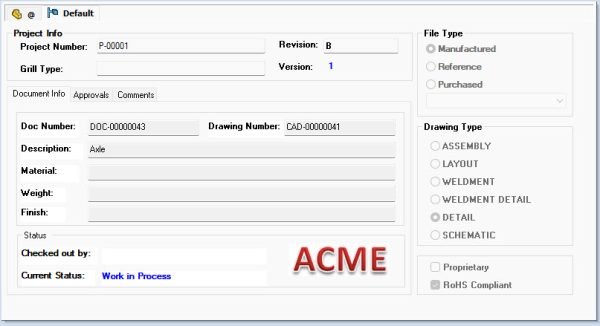 SOLIDWORKS PDM data card for capturing information
Operating natively within the SOLIDWORKS PDM environment, templates allow administrators to define logic-driven behaviors for folder path generation, file naming schemes, custom property population, and data card field initialization. This level of automation ensures repeatable, error-resistant creation of project structures and documentation, enhancing operational efficiency, data integrity, and compliance with internal standards.
Utilizing Templates with Existing Data Cards
SOLIDWORKS PDM templates can get their data through several mechanisms, with the most streamlined and controlled method being the use of a data card. Template data cards are created using the SOLIDWORKS PDM Administration tool, following the same design principles as standard file or folder data cards.
In many scenarios, it’s advantageous to repurpose existing file data cards as template cards. This approach promotes consistency and leverages predefined custom properties and metadata mappings. The following example illustrates how to utilize an existing data card for SOLIDWORKS part files to capture metadata and automate file naming logic within a PDM template.
1. Selecting a Template Source
Begin by identifying a SOLIDWORKS file that will serve as the basis for your template. In this instance, a curated set of SOLIDWORKS files resides within the SOLIDWORKS PDM vault, each configured with preferred custom properties, units, and other document-specific settings. Storing these files within the vault is a prerequisite for template usage in PDM.

Identifying the source file for the SOLIDWORKS PDM template
It is also necessary to define which metadata should be captured and mapped to the file’s data card. This process begins by reviewing the existing data card configuration for SOLIDWORKS file types to identify relevant variables and property mappings.
2. Using Data Cards for Template Inputs
SOLIDWORKS PDM templates support multiple input types, with the most structured and controlled method being the use of template-specific data cards. These cards are configured using the SOLIDWORKS PDM Administration tool.

Adding a new data card to the template
In scenarios involving the creation of SOLIDWORKS file templates, it is often advantageous to repurpose existing file data cards as template data cards. This approach not only reinforces consistency across metadata but also capitalizes on established custom property mappings and variable configurations.
3. Variable Mapping from Template to Data Card
Following the selection of the source file, identify the metadata that needs to be captured and propagated through the template. This requires a detailed review of the existing data card associated with the relevant SOLIDWORKS file type to verify the presence and configuration of required variables, property mappings, and default values.
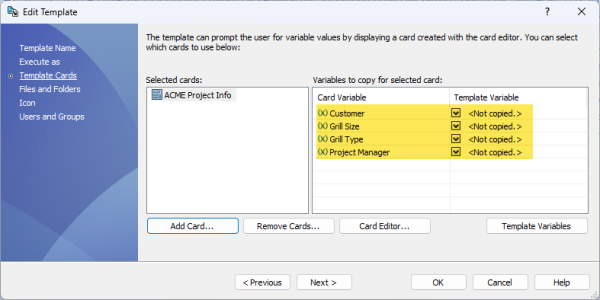
Linking variables from the data card to the template
These mappings are crucial for enabling automated behaviors, such as dynamic file naming, population of custom properties, and initialization of data card fields during template execution, thereby ensuring consistency, accuracy, and compliance with organizational standards.
4. Configuring Part Number Generation
The configuration process for part number generation within SOLIDWORKS PDM is straightforward and highly customizable. Input values can be defined manually or dynamically sourced, depending on the desired level of integration.
If an alias list is not required, administrators may opt for a standard list or an SQL-driven list. Utilizing SQL queries enables the retrieval of data from external enterprise systems such as Enterprise Resource Planning (ERP) or Manufacturing Resource Planning (MRP) platforms, facilitating seamless interoperability.
5. Linking Part Numbers to SOLIDWORKS PDM Template Variables
Once the components of the part number are defined, they must be integrated into the data card for use during template execution. The Prefix is implemented as a drop-down list. The Body and Suffix are implemented as text boxes. To preserve the integrity of serialized values and prevent unintended user modification, the body and suffix fields should be configured as read-only.

Creating additional template variables
Ensuring Data Integrity and Automation
When using an alias list for the prefix, assigning a default vault value can interfere with the automatic generation of part numbers. To avoid this issue, it is recommended to configure the prefix variable as mandatory, thereby preventing users from proceeding without selecting a valid value.
The Number field, which represents the complete part number, should be configured with an input formula that concatenates the prefix, body, and suffix components. This field should also be set to read-only to ensure that the computed value remains consistent and tamper-proof. The resulting serial number can then be used to automatically name the file during template execution, ensuring standardized and traceable file naming conventions.
Advanced SOLIDWORKS PDM Customization
Using SOLIDWORKS PDM templates is the best way to help enforce organizational standards and mitigate risks associated with redundant or misplaced data. However, templates are just scratching the surface of what can be customized and automated with SOLIDWORKS PDM. TriMech group has a dedicated Professional Services division ready to help you understand, customize, and automate your company’s SOLIDWORKS PDM vault.
To learn more about our SOLIDWORKS PDM customization and other services, click here.
Cloud Software
law
4
Berita Olahraga
Lowongan Kerja
Berita Terkini
Berita Terbaru
Berita Teknologi
Seputar Teknologi
Berita Politik
Resep Masakan
Pendidikan