If you’ve ever struggled to get clean, closed contours or found yourself fighting with uncooperative SOLIDWORKS sketches, this post is for you. Choosing the best sketch method might seem straightforward at first, but it depends on the type of sketch tool used and the desired result.
What SOLIDWORKS Sketch Methods Exist?
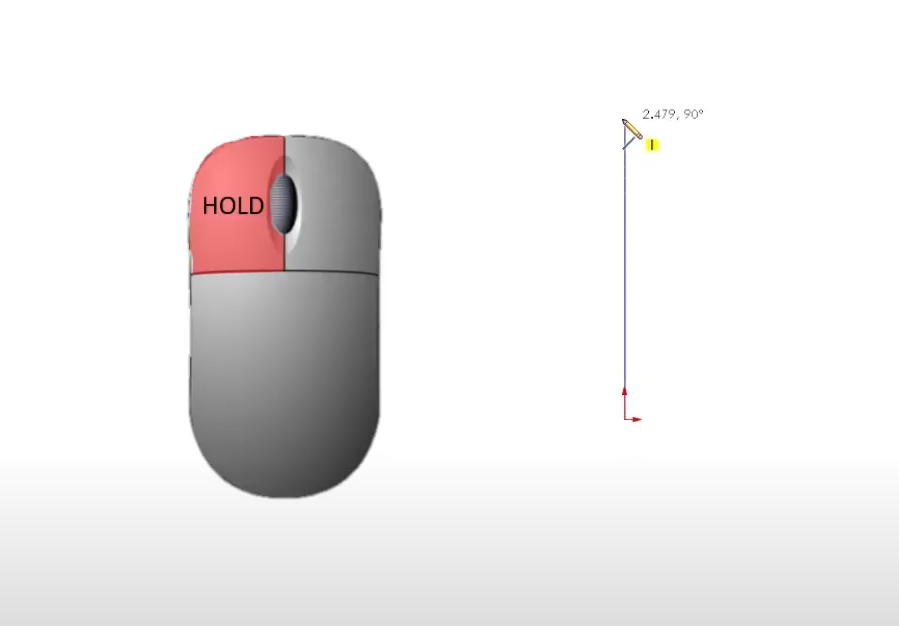
With SOLIDWORKS sketches, you are generally going to use one of two methods. The first is the click-and-drag method, meaning that you click and hold the mouse button, then drag the cursor to create the entity, before finally releasing the mouse button.
The second method is the click-click way of creating sketch entities. In this method, you click the mouse button to drop the first point, then drag the cursor to create the entity, before finally clicking a second time to finalize the sketch.
Using the Click-And-Drag Method
Let’s start with an example of the click-and-drag method. For example, if I’m drawing a line starting at the origin, I’ll click and hold the mouse button while dragging the cursor in the desired direction. Once I reach the right spot, I release the mouse to place the line.
The click-and-drag method creates one sketch entity at a time. To continue sketching, I repeat the process of click, hold, drag, release. In the case of sketching something like an L-shaped bracket, I would need to keep clicking and dragging for each new segment, making sure to manually reconnect to previous endpoints. And that’s where new SOLIDWORKS users often run into issues.
 Drawing a line with click-and-drag
This method also applies to other sketch entities, such as circles or polygons. For example, they can be sketched using click-and-drag, where the first click determines the center point, and the drag determines the polygon’s size.
Avoid Common Mistakes With This Method
One of the most common mistakes with this method is missing a connection between two lines, leaving your sketch open when you meant to create a closed shape. SOLIDWORKS won’t be happy with that, as it needs a fully closed contour for features like extrude, cut, or revolve.
While it is easy enough to fix by dragging one endpoint onto another, the risk of error is higher, especially for new users. Additionally, I find that holding the mouse button down for the duration of the action is more tedious and cumbersome, especially when aiming for precise endpoint targets.
Using the Click-Click Method
The click-click sketch method is sometimes referred to as the click-move-click method because it gives you freedom to move your mouse between clicks.
Here’s how it works:
-
Click once to start your line.
-
Move your mouse to the desired endpoint.
-
Click again to finish the line.

Drawing a polyline with the click-click method
This method can be used for other sketch entities as well. For example, when drawing a circle, the first click determines the center point and the second click sets the diameter. When drawing a corner rectangle, the first click initiates the rectangle, and the second determines the opposite corner position.
Benefits of Using This Method
The biggest benefit of this method is that your hands are free between clicks, and you don’t have to hold the left mouse button down. You can zoom, pan, and fine-tune the endpoint placement without the pressure of keeping the button pressed.
SOLIDWORKS treats sketches created with this method as polylines. After placing one segment, the next starts automatically connected from the endpoint of the last, making it easier to draw continuous shapes with precise alignment.

A closed SOLIDWORKS polygon denoted by the shaded appearance
SOLIDWORKS will also recognize when you have finished a closed contour, so when you end a line at the same point where another line began, the mouse stops drawing more lines. If you want to stop sketching polylines, but the line tool is still prompting you to place a fourth, double-click anywhere in space to finish the last segment, or hit the Escape key on your keyboard.
What is the Best Sketch Method for You?
Sketching with click-and-drag is a valid sketching method, and in some cases can be a quick, single-entity shortcut. But overusing it (especially without knowing the alternative) can lead to clunky workflows, missed endpoints, and unnecessary frustration.
Click-click is generally more precise, efficient, and beginner-friendly once you understand how it works. Having both methods in your skillset is what takes you from novice to a SOLIDWORKS professional!
Ready to certify your SOLIDWORKS skills? Register for an upcoming SOLIDWORKS CSWP Exam Prep Workshop here.
News
Berita Teknologi
Berita Olahraga
Sports news
sports
Motivation
football prediction
technology
Berita Technologi
Berita Terkini
Tempat Wisata
News Flash
Football
Gaming
Game News
Gamers
Jasa Artikel
Jasa Backlink
Agen234
Agen234
Agen234
Resep
Cek Ongkir Cargo
Download Film


